Wednesday, August 20, 2014

KAYA | 'PINAS, MAKAKAAHON BA 'PAG DUMATING ANG DELUBYO?


'PINAS, MAKAKAAHON BA 'PAG DUMATING ANG DELUBYO? PART 1 

'PINAS, MAKAKAAHON BA 'PAG DUMATING ANG DELUBYO? PART 2

'PINAS, MAKAKAAHON BA 'PAG DUMATING ANG DELUBYO? PART 3

'PINAS, MAKAKAAHON BA 'PAG DUMATING ANG DELUBYO? PART 4

'PINAS, MAKAKAAHON BA 'PAG DUMATING ANG DELUBYO? PART 5

Movie: After the Dark (End of the world by Nuclear Holocost)


At an international school in Jakarta, a philosophy teacher challenges his class of twenty graduating seniors to choose which ten of them would take shelter underground and reboot the human race in the event of a nuclear apocalypse.

Fugishima Nuclear Radiation Mass Effect


WHAT IS 'SAFE' RADIATION LEVELS IN WATER? I'll tell you - 10 becquerels per litre. The water leaking into the Pacific Ocean every day from the FUKUSHIMA PLANT is 230 million becquerels per litre - this is finally admitted by Tepco spokesman Masayuki - I say its time now to declare a WORLD HERITAGE DEAD ZONE and dump all nuclear waste and old cores on the same FUKUSHIMA PLANT - undermine the structure a bit and insert barium and boron crystals, encase it in lead and layers of concrete AND STOP IT FROM POISONING THE PACIFIC - Every 3 years we should add an extra 6 feet of shielding - and at the end of 25,000 years, the FUKUSHIMA DEAD ZONE will be the size of Germany and France combined... Yes that is a horrible fact - but we MUST DO SOMETHING NOW - and all that water being pumped onto those cores must STOP - now! The cores have 'pancaked' and yes they may even reach the WATER TABLE and that means that all FRESH WATER in the entire region will become contaminated - it's time now to admit that this is a GLOBAL DISASTER worse than CHERNOBYL in 1986 (which already poisoned a third of the planet) - we have to ACT NOW and SAVE THE SEA... THAT'S THE REALITY - THAT IS WHAT HAS TO HAPPEN - and we need a 'Thunderbirds' type INTERNATIONAL RESCUE mission IMMEDIATELY - otherwise more mass deaths and whale and dolphin dead wash-ups will occur and the whole of the western seaboard of Alaska, California and Hawaii will be ruined with radioactivity... Already, we have mysterious mass deaths of dolphins around the planet. They blame a virus. Bollocks. It's radiation sickness. And PELICANS have been killed too - at least 150 of them in PERU. A becquerel is a unit used to measure radioactivity. Here's a FUKUSHIMA DISASTER RE-CAP: July 2013: A TV Host who says vegetables grown near Fukushima are safe, cooks a meal on TV from garden veg and contracts a nasty cancer. 9 Oct 2013: Six workers are accidentally doused in radioactive water 7 Oct 2013: A plant worker accidentally switches off power to pumps used for cooling damaged reactors 3 Oct 2013: Tepco says there is a radioactive water leak after workers overfill a storage tank 21 Aug 2013: Japan's nuclear agency upgrades Fukushima alert level 20 Aug 2013: Tepco says 300 tonnes of radioactive water has leaked from a storage tank into the ground (add a few zeros on for the TRUTH) July 2013: Tepco for the first time admits radioactive water is going into the sea (it's been going on since the first day) June 2013: Tepco says radioactive water leaking from a storage tank to the ground... April 2013: Tepco suspects a fresh radioactive water leak at Fukushima (They'd known for ages, lol) March 2013: Tepco suspects a rodent may have been behind a power cut that shut down cooling systems (unlikely) Dec 2011 Contaminated water leaks from a treatment system, caused by a crack in the foundation The operator says the leak occurred when contaminated water was accidentally pumped into a large storage tank that was already full (yep, another lie) 2012-2014: Unusual historic-proprotioned DOLPHIN MASS DEATHS happen all around the planet.

Ebook: Spaceship, Multi Planet Species, Spacestation para ika survive ng lahi ng Tao.


Ebook:
Spaceship, Multi Planet Species, Spacestation para ika survive ng lahi ng Tao.

Saturday, August 9, 2014

Analog vs Digital Tv


What makes digital television so special? A digital image isn't inherently better than an analog image, and in some cases it can be worse. An HDTV picture doesn't have to be digital either; Japanese HDTV is broadcast over an analog signal. There has to be another reason why the United States is choosing to go through the pain of switching from analog to digital.
In fact, there are several good reasons to go digital, including: how much data it can transmit, how consistent the data stays over distance, and what type of data the signal can carry. For the same amount of bandwidth, you can stuff a lot more information into a digital signal than an analog signal. A digital signal doesn't produce the same problems with the picture we see on a distant analog television, either. And television in the digital age won't be limited to video and audio; our televisions will become truly interactive. Combined with HDTV and digital sound, this means a better picture, better sound, and digital data. But how are we going to fit all this into the same amount of frequency?


Unlike many other countries, the United States is converting to both digital signals and high-definition pictures at the same time. Some countries are already broadcasting high-definition pictures, but they're using an analog signal. To send more picture detail, they just expanded the amount of frequency bandwidth for each. Broadcasters in the United States won't have the option to expand the size of their signal. They'll have to squeeze more picture detail into the same bandwidth they were using for analog television.
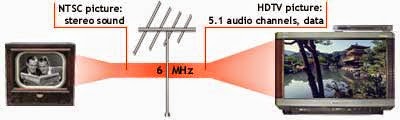
An advantage digital has over analog is that analog signals can't be compressed as well as a digital signal can. To transmit an image on analog television, every pixel is included in the signal. A standard NTSC screen includes 525 lines of 720 pixels, for a total of 378,000 pixels per frame. That's a lot, but it fits into the 6MHz bandwidth of a television channel. Japanese HDTV takes 20 MHz of bandwidth to send pictures with over 675,000 pixels. That's over two times as much signal to send a high definition picture and higher quality sound, but no other data.
In the United States, a standard ATSC (Advanced Television Systems Committee) screen can have up to 1080 lines of 1920 pixels each, or 2,073,600 pixels per frame. Somehow, more than five times as much information will need to squeeze into the same bandwidth of 6Mhz. That doesn't include the compressed audio or data. So how are they going to do that? The same way the compression software on your computer squeezes your files. Well, almost the same way.
Remember the days before cable television when someone in the family would assume the job of antenna contortionist? To improve that ephemeral picture to a viewable standard, they would skillfully adjust the alignment, length, and altitude of the antenna to get the best possible picture. But sometimes the picture would still show a foggy double image or ghostly images from the next channel. All these problems are caused by the weak signals from distant or blocked transmitters.
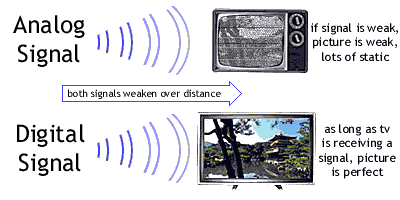
A basic natural law that our technology can't overcome is the weakening of television signals as they travel away from the transmitter and around or through objects. Both analog and digital signals get weaker with distance. However, while the picture on an analog TV slowly gets worse for more distant receivers, a picture on a digital set will stay perfect until the signal becomes too weak for the receiver to pick it up. By perfect I mean the picture on the TV is exactly the same picture the broadcaster started with at the transmitter. In a digital signal, a one is always a one and a zero is always a zero.

Thursday, August 7, 2014

Spying among Darkside


Study predicts Antarctic ice melting will endure


Study predicts Antarctic ice melting will endure

Posted at 02/21/2014 9:05 AM | Updated as of 02/21/2014 9:05 AM
WASHINGTON - The melting of ice in the Antarctic is considered a top threat to global sea level rise, and scientists said Thursday the trend could continue for decades or even centuries to come.
Researchers focused on the Pine Island Glacier in Antarctica, which has been thinning at an increasingly rapid pace for about the past 20 years, as the waters beneath get warmer along with the rest of the ocean.
Based on new geological surveys and advanced dating techniques on rocks that have been exposed by the retreating ice, experts said in the journal Science that a similar phenomenon occurred thousands of years ago.
Some 8,000 years ago, the glacier thinned as fast as it has in recent decades, suggesting it may follow a similar pattern in the future, they reported.
"This thinning was sustained for decades to centuries at an average rate of more than 100 centimeters per year, comparable to contemporary thinning rates," said the article in Science.
"Our findings reveal that Pine Island Glacier has experienced rapid thinning at least once in the past, and that, once set in motion, rapid ice sheet changes in this region can persist for centuries."
The research team came from Britain, Germany and the United States.
Last month, scientists reported in the journal Nature Climate Change that the glacier was melting irreversibly and could add as much as a centimeter (0.4 inches) to ocean levels in 20 years.
A massive river of ice, the glacier by itself is responsible for 20 percent of total ice loss from the West Antarctic Ice Sheet today.
On average, it shed 20 billion tonnes of ice annually from 1992-2011, a loss that is likely to increase up to and above 100 billion tonnes each year, said the Nature study.

http://www.abs-cbnnews.com/global-filipino/world/02/21/14/study-predicts-antarctic-ice-melting-will-endure